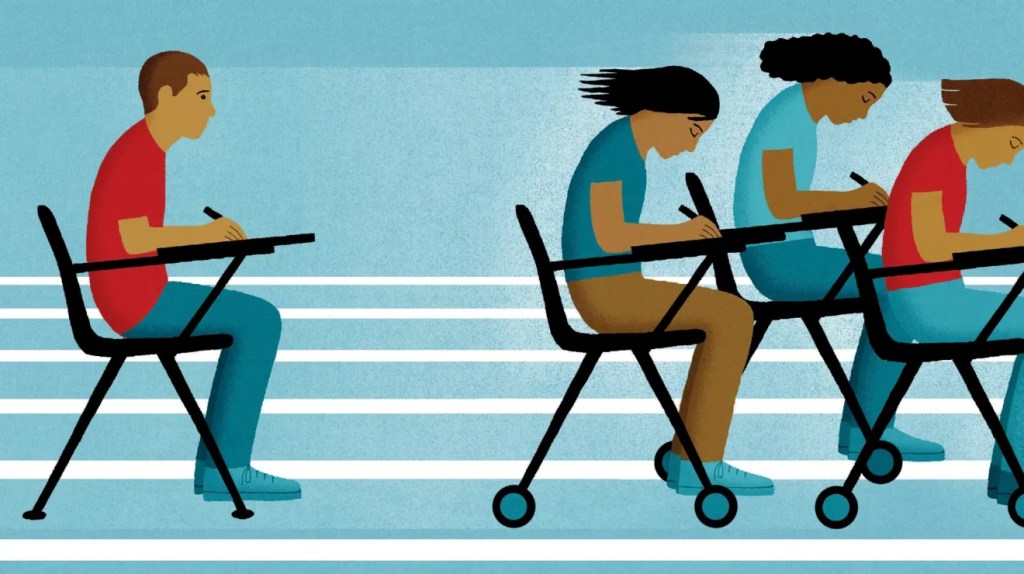
Illustration by James Steinberg
(Please note: although this article adopts the rhetorical style of the original magazine piece, it also acknowledges a broader spectrum of gender identities that a person may belong to.)
According to a recent Harvard Magazine article, American girls now consistently outperform boys in primary and secondary school, graduating at higher rates and earning better grades. The shift is more than anecdotal; it’s statistical. Today, women earn nearly 60 percent of all bachelor’s degrees—a reversal of the gender ratio from just three decades ago.
This quiet but profound transformation is playing out across classrooms, campuses, and careers. Increasingly, young women are pursuing advanced education and entering the professional workforce in growing numbers. Meanwhile, more young men are turning toward trade schools, choosing hands-on training and fieldwork over four-year degrees. It’s not a collapse of ambition—it’s a redirection.
What does it mean when success in conventional classrooms no longer maps evenly across gender lines? And what might we reimagine, not only for kids, but for an educational model that meets a broader spectrum of minds?
It’s a question worth serious consideration in Canada as well —especially for the educators, policymakers, and parents shaping the next generation. Perhaps it’s time to reflect on how we define learning and success, and on the early expectations we begin placing on children from the very first day they step into a classroom.
 Amber Ye
Leave a comment